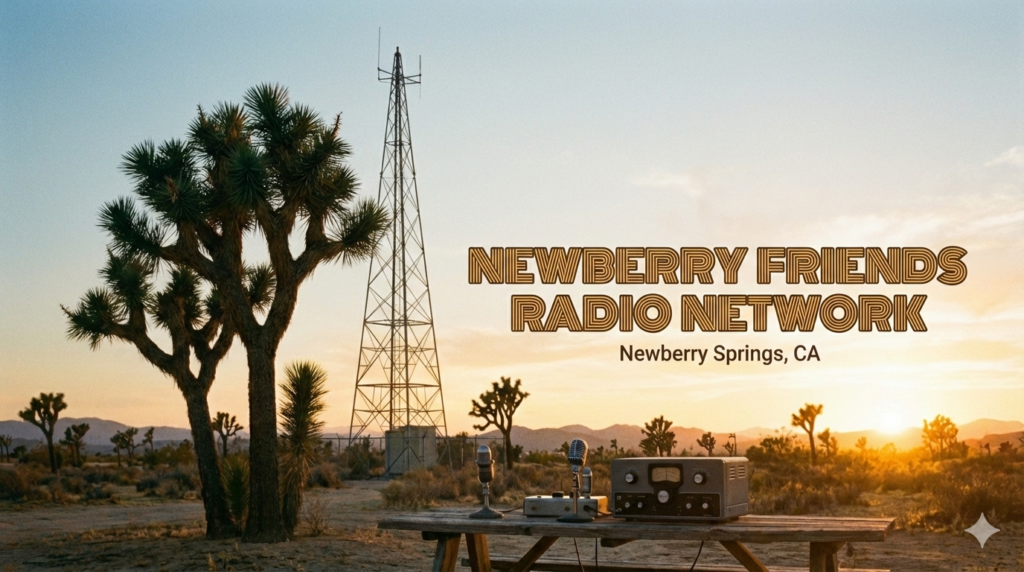
Welcome to the NFRN website
The Newberry Friends Radio Network is a locally-focused, volunteer Emergency Communications network for Newberry Springs. We use hand-held, FCC-licensed GMRS (General Mobile Radio Service) radios and a UHF (ultra-high frequency) radio repeater to completely cover our 100-square mile community.
The NFRN uses the same UHF repeater technology used by both FCC-licensed amateur radio operators and commercial two-way radio operators however the GMRS frequency band is designated by the FCC (Federal Communications Commission) for use by families and communities and not by businesses. Network membership is open, no charge, to every constructive and responsible member of the community.
Any individual or community in the United States can, in theory, build an emergency communications network like the NFRN using GMRS frequencies. Our network is supported by local amateur radio operators, by the Silver Valley Repeater System and by silverhost.net.
Join us as we build a resilient, informed, and connected community. For more information please see the FAQ (below) and then call 818-577-7798.
Latest News
- NFRN Launches Meshtastic Network
 NFRN Adopts Meshtastic and the SoCal Mesh Configuration Meshtastic is an open-source, off-grid communication platform that allows anyone to send secure text messages and share GPS coordinates completely without cell service or internet connection. By pairing a low-power LoRa radio device to your smartphone via Bluetooth, you create a resilient, peer-to-peer network. Every active device… Read more: NFRN Launches Meshtastic Network
 - BARC to host 2026 Field Day
 ARRL Field Day 2026 will be held June 27 to 28, the last weekend in June. Barstow Amateur Radio Club BARC will again have an entry with our systems set up near the Barstow Community Hospital. We are planning to have 3 or 4 transmitters, plus V/UHF and GOTA stations. Field Day introduces new operators… Read more: BARC to host 2026 Field Day
 - BitChat Peer to Peer Messaging over Bluetooth
 Local Airwaves Meet Local Networks: Introducing BitChat Imagine a messaging tool that does not need the internet, cell towers, or big tech servers to work. The Newberry Friends Radio Network is all about community resilience and independent communication. That is why we are highlighting BitChat.free, a breakthrough mobile application designed to keep you connected while… Read more: BitChat Peer to Peer Messaging over Bluetooth
 - 2026 Technician Class License Class
 The Barstow Amateur Radio Club has announced that they are hosting their 2026 Technician License Classes starting on Monday, February 2nd, 2026. The Classes will be held over Zoom from 6PM to 8PM. You do not need to be a member of the Barstow Amateur Radio Club to attend the classes, and there is no… Read more: 2026 Technician Class License Class
Frequently Asked Questions
We are the Newberry Friends Radio Network (NFRN).
The NFRN is a volunteer emergency communications network serving the Newberry Springs Community. We are a non-profit “unincorporated association” under California law.
In an emergency such as an earthquake, a war or other major emergency, cellphones and the Internet may not be working. Trained emergency communicators will be needed to help the community to adapt, to survive and to recover. We expect that the NFRN system will still work when all other means of communication may not be working.
Members will call for help if they need help. If a member does not need help, they will make themselves available to help others in the community who are in need. Members have no law enforcement, emergency medical or firefighting authority. Our role is simply to 1) keep ourselves safe and healthy so we can help others and (2) provide emergency communications to members of our community, including public safety personnel if they ask for our help. Members are expected to exercise good judgement and discretion at all times.
Constructive and responsible members of the community may apply for membership. In addition, some community members who already fill leadership roles will be invited to become members. Membership is not guaranteed. Community members who have a personal history of illegal, destructive, dishonest or disrespectful behavior will not be admitted. Further, any member who uses the network to commit any illegal act will be removed from the organization. All membership decisions will be made by NFRN management.
The Federal Communications Commission has created the General Mobile Radio Service (GMRS) and allocated the use of specific UHF (ultra high frequency) channels. We will use hand-held GMRS radios on these channels. A NFRN member who spends a lot of time on the road in a vehicle may also choose to purchase a higher-power “mobile” radio to install permanently in their vehicle. A mobile radio is safer to use while driving compared to using a handheld radio.
Yes. Members are responsible for applying for an FCC GMRS license which costs $35 and is valid for ten years. The license is valid not just for the individual licensee but for all members of their immediate family therefore having a GMRS license is a good way to keep in touch with your family. Operation on the Newberry repeater BEFORE you obtain a GMRS license is authorized as long as you use your assigned tactical call sign.
The NFRN is an emergency communications organization. For training and emergency communications purposes, NFRN will permit not-yet-licensed volunteers to use the organizations communications resources and participate in NFRN emergency communications training. NFRN will help members to complete their online FCC GMRS license applications. After applying online, the FCC issues licenses via email in about one week.
We will use NFRN-assigned tactical call signs that, for security reasons, will be non-obvious to outsiders. In addition, NFRN members who have already obtained their GMRS licenses will also use their FCC-assigned GMRS call sign to identify their transmissions each hour. Our over-the-air transmissions are not encrypted and the GMRS frequencies are shared so anyone (outsiders, criminals, etc.) listening in on the GMRS frequencies can hear our transmissions. This means that NFRN members must be both thoughtful and discrete in choosing their words when transmitting. Finally, from time to time, we will likely hear transmissions from other, non-NFRN GMRS users. In general and in non-emergencies, we should disregard (don’t reply to) those transmissions.
No. The NFRN repeater has been built by and is supported by licensed Newberry Springs amateur radio operators. All licensed Newberry ham radio operators are encouraged to become NFRN members but the NFRN uses GMRS frequencies, not ham radio frequencies. Non-ham NFRN volunteers will be learning communications practices and technologies that will be helpful if and when they later choose to take the FCC test for an amateur radio license.
No. Business users should apply to the FCC for a licensed business band frequency. The NFRN should not be used for normal business operation although in an actual emergency where the safety of life or property is threatened, NFRN resources can be used.
Yes. You can use your NFRN radio in simplex (non-repeater) mode but you should not plan to use the NFRN repeater for non-NFRN events unless either
- You obtain approval in advance from NFRN management or
- You come upon an actual emergency and need to request help.
Extensive use of the NFRN repeater for a non-NFRN, non-coordinated event will tie-up the repeater and could prevent needed emergency traffic from getting through.
No, there are many different GMRS handheld radios that can be used. There are also many FRS (Family Radio Service) handheld radios that look like GMRS radios however FRS radios will not work on the NFRN GMRS repeater frequencies. Currently, the BAOFENG G11S is a good handheld radio choice for NFRN members. It is currently available on Amazon as a “two pack” (two radios) for $50 which is $25 per radio.
NFRN has received a donation of a limited number of older-model handheld radios that can be temporarily assigned to (borrowed by) NFRN members who are in “active” status. Every active member needs to have at least one radio, either owned or borrowed and the sooner, the better so that we will be able to quickly serve the Newberry Springs community.
We will have one meetings each month where attendance will be taken. To maintain “active” status, members must attend one half of the scheduled meetings. If needed, for members who are unable to travel, we will schedule training sessions on the Internet using Zoom. We will also have an on-the-air check-in net meeting each week lasting about 20 minutes. Roll will be called. These meetings are designed to allow members to check that their equipment is operating properly and to receive relevant, up-to-date community information. Members should plan to attend at least one half of these on-the-air check-in net meetings.
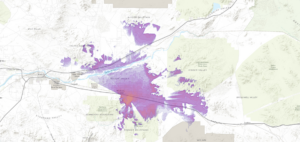
The average range with a UHF handheld radio is determined by the number of obstructions between two radios. For example, trees and buildings will reduce the communications range. In Newberry, the average direct communications distance may be two to three miles. Direct radio-to-radio communication is called “simplex” or “direct” operation. UHF handheld communications range can be extended by using a “repeater”. Repeater operation is called “duplex” operation.
Any signal that the repeater receives on the repeater “input” frequency is simultaneously retransmitted on the “output” frequency. The communications distance (the “coverage”) of a repeater depends on the height above ground of the repeater antenna. The higher the repeater antenna, the less obstructions there are between a handheld radio antenna and the repeater antenna and the greater the repeater coverage distance. NFRN will initially be using a repeater located in northwest Newberry Springs with an antenna 30 feet above the ground. This repeater is expected to provide coverage to all of Newberry Springs between NFRN members using handheld radios. During testing, coverage has extended as far as Barstow in some cases.
Keep each transmission short (no longer than two minutes). Before you transmit, think about what you are going to say and how you can keep your transmission brief. Repeaters are designed to support short transmissions; they are not the place for long-winded people to ramble on and on. After three minutes, the repeater cuts transmissions off. If you have a lot of information to send, make a series of short repeater transmissions. If you have a lot of personal (non-NFRN) information to share and you are close to the other station, please switch to one of the simplex (non-repeater) frequencies.
Wait and listen after the other station stops transmitting before you begin transmitting. You will hear a “kerchunk” sound which indicates that the repeater has stopped transmitting and has reset the three-minute timer. After the “kerchunk”, key your transmitter, count silently to 2 and then begin speaking.
Email jack@ungersafe.net or phone (818) 577-7798.
The Newberry Friends Radio Network is a non-profit Community Services organization and is supported by donations. If you wish to support us, one of the best ways would be to help pay the $35 FCC GMRS license fee for members who can not currently afford to pay. Another way to help would be to buy a GMRS radio for another member who can not currently afford a radio. In either case, feel free to contact network management for more information.